Hello, it’s matt here.
There’s a real joy in seeing the first signs of spring. Lesser celandine creates a beautiful display of yellow stars along the river bank after what often feels like a long and grey winter, the first song of returning migrants like the chiff-chaff chewing through its two-note performance. The Marsham family (link – https://academic.oup.com/jxb/article/61/11/2853/440390) must have thought something similar and for a whopping 211 years recorded “indications of spring” – a collection of information on the first time they saw a range of different plants as they came into flower that year – until they were told they were no longer of use.
But this type of anecdotal evidence gave birth to a study known as ‘phenology’ – where we examine the effect of environmental changes on nature which is extremely important as we experience the effects of climate breakdown (if only the Marsham family had continued!!).
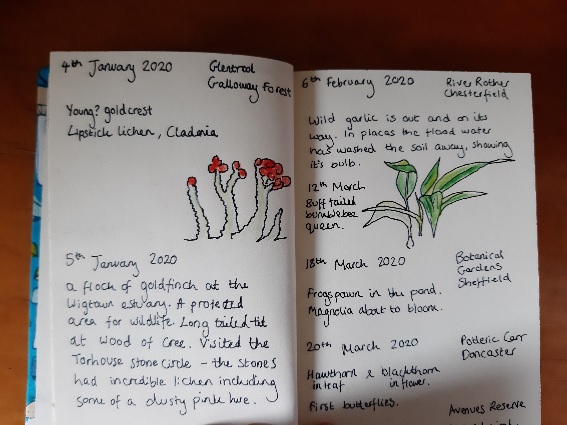
Keeping a nature jounal has an added benefit of helping us remember what we’ve seen that day, taking an opportunity to savour our favourite moments and if we’re ever feeling a bit depleted we can even look back on it in years to come and remember “that time I saw…”.
Our friends at Sheffield and Rotherham Wildlife Trust have made this great video for nature journaling with kids
[youtube https://www.youtube.com/watch?v=n_PvESFHNH4&w=560&h=315]
But if I’m truly honest, despite loving seeing nature and talking about it ALOT, I don’t actually keep one myself so I’m going to challenge myself to keep one for a week and I’ll let you know how it goes.
Here’s a few ideas of what I might include in mine –
- Date, time and location
- What was it, how many?
- How were they behaving?
- A small sketch of what it looked like.
Here’s a page from Sally’s for inspiration